Newborn Sleep: A Complete Science-Backed Guide for New Parents
On this page

Bringing a newborn home is one of life's most joyful — and sleep-deprived — experiences. Understanding how and why newborns sleep the way they do is the first step toward surviving (and thriving through) those early weeks. This evidence-based guide walks you through everything, from the neuroscience of infant sleep to the AAP's 2024 safe sleep guidelines. As your baby grows, see our baby sleep schedule by age guide for month-by-month nap counts and wake windows from newborn to 12 months.
Normal Newborn Sleep Patterns
Newborns sleep a lot — but rarely when you want them to. In the first few weeks of life, babies typically sleep 14–17 hours per 24-hour period, broken into short stretches of 2–4 hours. This fragmented pattern exists for good biological reason: a newborn's stomach is tiny (about the size of a marble at birth), so they need to feed frequently, including during the night.
Unlike adults, newborns don't yet have an established circadian rhythm. This internal clock — driven by melatonin and cortisol — takes 3–4 months to develop. Until then, babies are genuinely incapable of distinguishing day from night. You can help set the stage by exposing your baby to bright natural light during the day and keeping nights dark and quiet, but don't expect miracles before the 12-week mark.
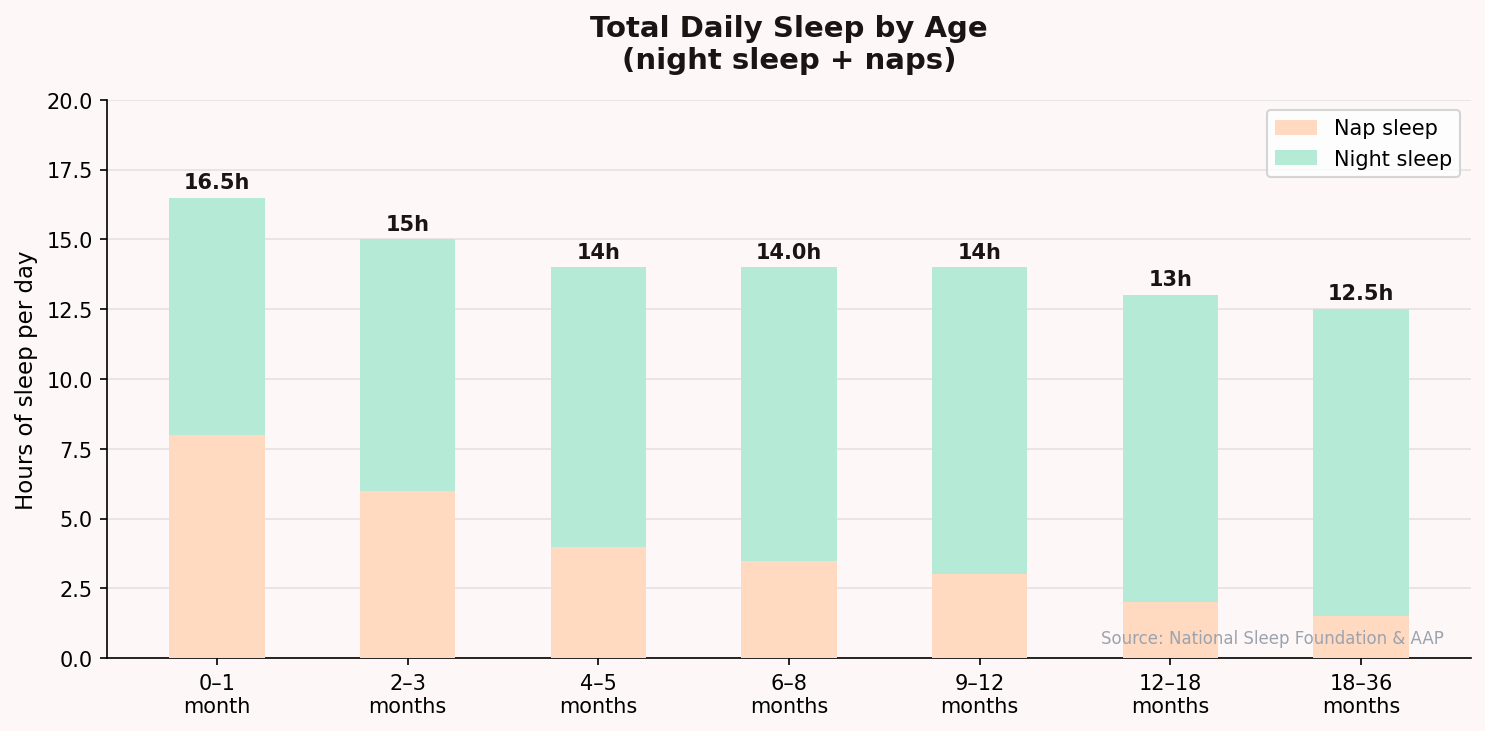
Average total sleep hours per 24-hour period by age. Source: National Sleep Foundation / AAP.
What "Sleeping Through the Night" Actually Means
The phrase "sleeping through the night" is often misunderstood. Pediatric sleep researchers define it as a 5–6 hour unbroken stretch, not the 8–10 hours adults enjoy. Most babies don't achieve this until 3–4 months of age at the earliest, and many take longer. This is completely normal and healthy. Expecting a 4-week-old to sleep 8 hours is unrealistic and can lead to unnecessary anxiety for parents.
| Age | Total Sleep / 24h | Naps per Day | Longest Stretch |
|---|---|---|---|
| Week 1–2 | 16–18 hours | 5–7 | 2–3 hours |
| Week 3–4 | 15–17 hours | 4–6 | 2–4 hours |
| Week 5–8 | 14–17 hours | 4–5 | 3–4 hours |
| Week 9–12 | 14–16 hours | 3–5 | 4–6 hours |
| Month 4 | 13–15 hours | 3–4 | 5–8 hours |
| Month 6 | 12–15 hours | 2–3 | 6–10 hours |
The Science of Newborn Sleep Cycles
Adult sleep cycles last approximately 90 minutes and cycle through four distinct stages: N1 (light), N2 (light), N3 (deep/slow-wave), and REM. Newborn sleep is fundamentally different. Babies are born with only two sleep stages: active sleep (similar to REM) and quiet sleep (similar to deep sleep). Their cycles last just 40–50 minutes.
This is why your baby may wake at seemingly random times — they're simply completing a sleep cycle and briefly rousing between cycles, just as adults do, but without the ability to return to sleep independently (a skill that develops with time and, eventually, practice).
Active sleep is easily identifiable: your baby may twitch, grimace, make noises, or even open their eyes briefly. This is completely normal and is actually thought to support brain development. Resist the urge to pick them up immediately at every sound — give them 30–60 seconds to see if they settle back on their own.
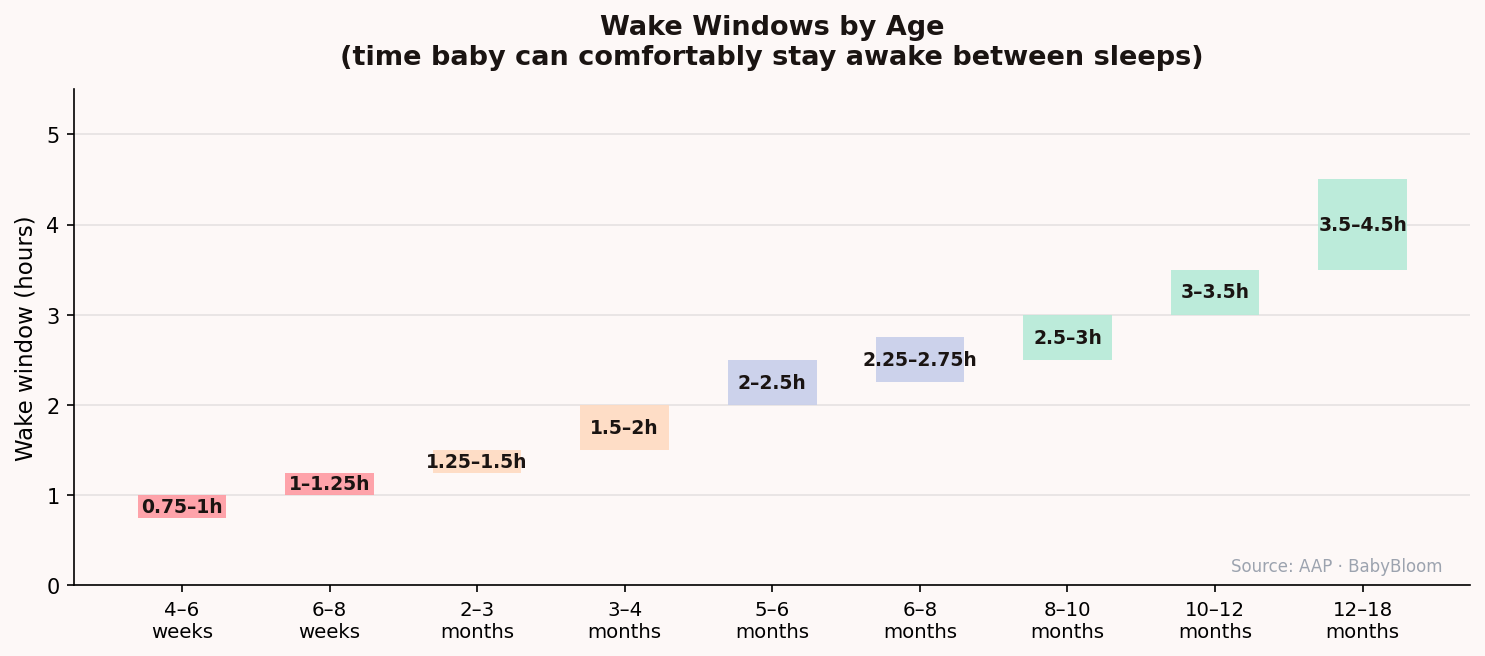
Appropriate wake windows by age. Keeping baby in these ranges reduces overtiredness and helps consolidate sleep.
Wake Windows: The Key to Preventing Overtiredness
One of the most powerful tools for new parents is the concept of "wake windows" — the appropriate amount of awake time before the next sleep. Overtired babies produce excess cortisol, which actually makes it harder for them to fall and stay asleep. For newborns under 6 weeks, wake windows are just 45–60 minutes. This includes feeding, diaper change, and a brief period of calm interaction. That's it. By 3 months, wake windows extend to about 75–90 minutes.
Safe Sleep: The ABC Guidelines
Safe sleep is not optional — it's life-saving. The American Academy of Pediatrics (AAP) updates its safe sleep guidelines regularly, and the 2024 version reinforces the ABCs of safe sleep: Alone, Back, Crib.
AAP Safe Sleep — Non-Negotiable Rules
Always place your baby Alone, on their Back, in a Crib (or other approved sleep surface). SIDS and sleep-related infant death rates drop dramatically when these guidelines are followed. There is no safe version of bed-sharing with a newborn.
Alone
Your baby should sleep alone in their own sleep space — not with you, not with siblings, and not with pets. Bed-sharing significantly increases the risk of suffocation and sleep-related infant death, even on a firm adult mattress with sober, non-smoking parents. The only exception is skin-to-skin contact immediately after birth, but this should happen only while you are fully awake and attended by a healthcare provider. The sleep consolidation patterns you're working toward are influenced by gestational age — babies born before 28 weeks have underdeveloped circadian rhythm infrastructure that affects early sleep organisation.
Back
Every sleep, every time — always place your baby on their back. This position keeps the airway open and reduces re-breathing of exhaled carbon dioxide. Back sleeping has been associated with a greater than 50% reduction in SIDS rates since the "Back to Sleep" campaign launched in 1994. Once your baby can roll both ways independently (typically around 4–6 months), you don't need to re-position them overnight — but always start them on their back. Birth preparation — including who will be in the room and your preferences for immediate skin-to-skin — should be finalised by 38 weeks pregnant.
Crib
Use a firm, flat sleep surface with a tight-fitting sheet. This includes CPSC-approved cribs, bassinets, and play yards. The surface should be completely bare — no pillows, no loose blankets, no bumpers, no positioners, no sleep wedges, and no soft toys. If you're worried your baby is cold, use a sleep sack (wearable blanket) instead of a loose blanket.
Swaddling: A Complete Guide
Swaddling — wrapping your baby snugly in a blanket — can be highly effective for calming and settling newborns. It mimics the snug environment of the womb and suppresses the Moro (startle) reflex, which can otherwise wake sleeping babies. When done correctly, swaddling is safe for newborns.
The key rules for safe swaddling:
- Hips must be free: Swaddle snugly around the arms and torso, but leave room for the hips to move. Tight swaddling around the hips can cause developmental hip dysplasia.
- Not too tight: You should be able to slip two fingers between the blanket and your baby's chest.
- Stop when rolling begins: The moment your baby shows any signs of rolling (typically 2–3 months), stop swaddling immediately. A swaddled baby who rolls onto their stomach cannot push up to free their airway.
- Always back to sleep: A swaddled baby must always be placed on their back.
Settling Techniques: The Five S's
Pediatrician Dr. Harvey Karp's "5 S's" method is one of the most evidence-supported approaches to calming a crying newborn and facilitating sleep onset. Each "S" activates the baby's innate calming reflex.
1. Swaddle
As described above — a snug wrap activates the feeling of security and suppresses the startle reflex.
2. Side or Stomach Position (for soothing only)
Holding your baby on their side or stomach activates the calming reflex. Important: this is for soothing while you are holding them — never place a sleeping baby on their side or stomach.
3. Shush
White noise is optional. Keep the volume low, the device well away from the baby, and exposure brief.
4. Swing
Gentle, jiggling motion — not rocking — calms many newborns. Think of the constant motion experienced in the womb during a day of walking. Small, rapid jiggles (while supporting the head) are more effective than slow swings for a deeply distressed baby. Always support the head and never shake a baby.
5. Suck
Sucking — whether at the breast, on a pacifier, or on a finger — engages a powerful calming response. The AAP actually recommends introducing a pacifier at sleep times after breastfeeding is established (around 3–4 weeks) as it is associated with a reduced risk of SIDS.
White Noise Tip
White noise helps mask household sounds that can startle a sleeping baby between sleep cycles. Keep the volume at or below 50 dB (roughly the level of a quiet conversation) and place the machine at least 7 feet from the baby's head. The AAP advises against playing white noise directly next to the infant's ear.
Establishing Healthy Sleep Habits
While "sleep training" is a topic for later (typically after 4–6 months), you can start building positive sleep associations from day one:
- Consistent sleep location: Try to have most sleeps happen in the same place.
- A simple wind-down routine: Even a 5-minute routine (feed, diaper, swaddle, shush) signals to your baby that sleep is coming.
- Drowsy but awake: As early as 6–8 weeks, try placing your baby down when they're calm and drowsy but not fully asleep. This is the foundation of independent sleep onset.
- Differentiate day and night: Keep daytime feeds social and bright; keep nighttime feeds calm, dark, and quiet.
- Avoid overtiredness: Watch wake windows carefully — an overtired baby is much harder to settle.
Feeding and Sleep
In the early weeks, feeding and sleep are inseparable. Newborns need to eat every 2–3 hours, including overnight. Formula-fed babies may go slightly longer between feeds (formula digests more slowly), but breastfed babies need frequent feeding to establish milk supply. Attempting to stretch feeds to "get more sleep" in the first 4–6 weeks can compromise your milk supply and your baby's weight gain.
As your baby grows and their stomach capacity increases, feeds naturally space out and nights gradually improve. Most babies are neurologically and physiologically capable of longer sleep stretches (5–6 hours) by around 12–16 weeks.
When to Call Your Pediatrician
Most newborn sleep concerns are normal, but some signs warrant a call to your doctor:
- Your baby is consistently sleeping more than 19 hours per day and is difficult to wake for feeds
- Your baby has not regained their birth weight by 2 weeks
- Your baby shows signs of jaundice (yellowing of skin or whites of eyes) and is sleeping excessively
- You notice pauses in breathing (apnea) lasting more than 10–15 seconds
- Your baby makes noisy, labored breathing sounds during sleep
- Sudden change in sleep patterns in a previously healthy older infant
When in doubt, always call. Pediatricians would much rather field a reassuring phone call than miss something important.
Frequently Asked Questions
Is it normal for a newborn to sleep all day?
Yes — newborns typically sleep 14–18 hours per day. However, they should be woken every 2–3 hours to feed in the first 2 weeks if they don't wake on their own, particularly if they haven't regained their birth weight yet. After that, if your baby is feeding well and gaining weight, it is generally safe to let them sleep.
When do newborns sleep through the night?
Most babies achieve a 5–6 hour unbroken stretch (the pediatric definition of "sleeping through") somewhere between 3–6 months. Full night sleep (10–12 hours) typically consolidates between 6–9 months. There is wide individual variation and many factors, including temperament, feeding method, and sleep environment, play a role.
Can my newborn sleep in a swing or bouncer?
No. Swings, bouncers, car seats, and inclined sleepers are not safe for unsupervised sleep. The inclined position can cause a baby's head to fall forward, blocking their airway. The FDA has banned inclined infant sleepers with angles greater than 10 degrees. Always transfer your baby to a firm, flat surface if they fall asleep in a swing or car seat.
Is co-sleeping ever safe?
The AAP advises against bed-sharing (sleeping on the same surface as an adult) for all infants due to the risk of suffocation. However, the AAP does recommend room-sharing — keeping your baby's sleep surface in the same room as you — for at least the first 6 months, ideally 12 months. This is associated with reduced SIDS risk and makes nighttime feeds easier.
My baby only sleeps when held — what should I do?
This is extremely common and completely normal in the first weeks. Babies are evolutionarily wired to want closeness. You can try the 5 S's, a firm swaddle, and placing your baby down "drowsy but awake" as a gentle first step. Babywearing in a safe carrier during the day can meet your baby's contact needs while giving you your hands back. Over time, most babies gradually accept independent sleep as they mature neurologically.
References
- American Academy of Pediatrics. (2024). Safe Sleep Recommendations. https://www.aap.org/en/patient-care/safe-sleep/
- Moon, R.Y., & Task Force on Sudden Infant Death Syndrome. (2022). Evidence base for 2022 updated recommendations for a safe infant sleeping environment. Pediatrics, 150(1). https://doi.org/10.1542/peds.2022-057991
- NHS. (2023). Help your baby to sleep. https://www.nhs.uk/conditions/baby/caring-for-a-newborn/help-your-baby-to-sleep/
- Centers for Disease Control and Prevention. (2024). Sudden Unexpected Infant Death and Sudden Infant Death Syndrome. https://www.cdc.gov/sids/data.htm
- Hirshkowitz, M., et al. (2015). National Sleep Foundation's sleep time duration recommendations. Sleep Health, 1(1), 40–43. https://doi.org/10.1016/j.sleh.2014.12.010
Your complete baby guide — free
Month-by-month milestones, sleep science, feeding roadmap, and 100+ expert tips. Science-backed, always free.
Open BabyBloom free →No account needed · No credit card