Contact Napping: Is It Safe, How Long It Lasts, and How to Stop
On this page
Quick answer: Is contact napping safe?
Yes. Contact napping is biologically normal and safe when the caregiver is awake and alert. It does not train babies to "only sleep on you" long-term — most babies self-resolve between 3–6 months as their sleep architecture matures. If you want to transition away, there are gradual methods that work without sleep training.
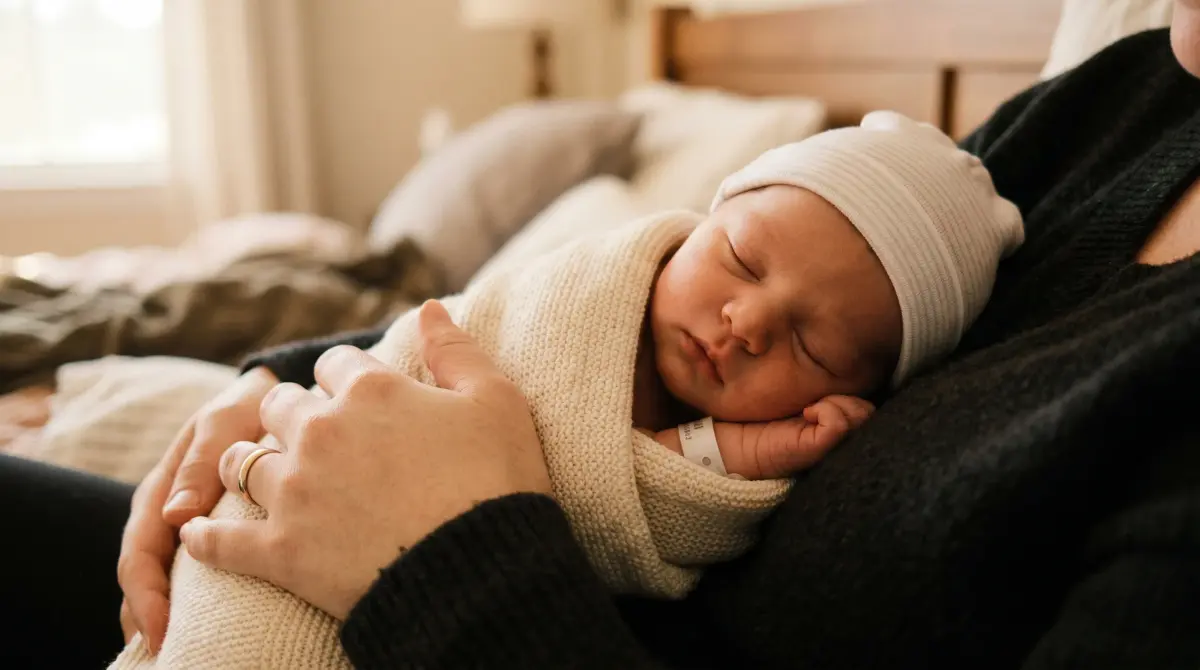
You planned to use naptime to eat a proper meal, make a phone call, or just sit somewhere without a baby on you. Instead, you're 90 minutes into a contact nap — back aching, phone out of reach, desperate for the bathroom — and the moment you attempt the transfer, those eyes snap open.
If this is your daily reality, you're in good company. Research suggests around 70% of infants under 6 months nap primarily on a caregiver. Contact napping is not a failure of sleep training or a sign that your baby is "spoiled." It's a deeply biological behaviour with specific developmental roots — and one that you can change when you're ready, not because someone told you that you should.
This guide covers the actual reasons babies contact nap, exactly when they can reasonably transition to independent naps, and step-by-step methods that work — including what to do when the transfer keeps failing. Find more in our complete baby sleep guide.
What Is a Contact Nap?
A contact nap is any nap where the baby sleeps on or against a caregiver — chest, lap, arms, or in a carrier. The baby's own sleep space (crib, bassinet, pram) is not involved.
Contact napping is distinct from bedsharing, though the two are often conflated. During a contact nap, the parent is (or should be) awake and actively supervising. The key variable that determines safety is parental alertness, not the act of holding itself.
What contact napping is not: It is not the same as a "nap association" in the problematic sense. Under about 4 months, babies lack the neurological development to self-settle regardless of how they're put down. You cannot train a newborn out of contact napping any more than you can train them to walk. This distinction matters because a lot of parental guilt is built on the misconception that holding a young baby "creates" problems that wouldn't otherwise exist.
Why Do Babies Contact Nap? (The Actual Reasons)
There are four overlapping biological reasons, each with research behind it. Understanding them doesn't solve the problem — but it does make the 3pm trapped-on-the-sofa feeling slightly less maddening.
1. The fourth trimester drive for proximity
Babies arrive neurologically underdeveloped compared to other mammals. A foal walks within hours of birth; a human newborn cannot even hold their own head up. Dr. Harvey Karp's "fourth trimester" framework captures this: in the first 3 months outside the womb, babies are essentially still foetal in their developmental needs. The womb provided constant warmth, motion, sound (your heartbeat), and pressure. Your chest replicates all four of those inputs simultaneously. The switch from womb to crib is, from the baby's nervous system perspective, a significant sensory deprivation event. See our newborn development guide for more on fourth trimester behaviour.
2. Active sleep and the light-sleep problem
Newborns spend approximately 50% of their sleep time in active (REM) sleep, compared to 20–25% in adults. REM sleep involves rapid eye movement, twitching, irregular breathing, and — critically — a much lower arousal threshold. Babies rouse constantly between sleep cycles. In adults, the brain bridges these transitions unconsciously; in infants, the bridge hasn't developed yet. Being held provides continuous proprioceptive and thermal input that suppresses full waking during these transitions. Put the same baby down and that sensory bridge disappears — the arousal that was suppressed now triggers a full wake.
3. Temperature regulation
Newborns cannot thermoregulate efficiently. Their body surface area relative to body mass is much higher than adults', meaning they lose heat quickly. Research from Dr. Nils Bergman's kangaroo care studies (and the earlier landmark work of Charpak et al., 2005) showed that a parent's chest acts as an active thermal regulator — it warms when the baby is cold and cools when the baby is too warm. A crib mattress, by contrast, is a passive surface that draws heat away. For a baby already prone to waking at the lightest sensory disruption, the thermal shift of being put down can be enough to trigger waking.
4. Cortisol suppression
A 2017 study in Developmental Psychobiology (Feldman et al.) measured cortisol levels in infants during periods of being held versus not held. Held infants showed significantly lower cortisol responses to mild stressors. Cortisol is the primary arousal hormone — lower cortisol = longer, deeper sleep. This is one reason contact-napping babies often nap for 90+ minutes while the same baby may last 30 minutes in a crib. It's not stubbornness. It's biochemistry.
Is Contact Napping Safe?
This question has a specific answer that depends entirely on one variable: whether the parent is awake.
A parent who is fully awake, alert, and can see the baby's face at all times — contact napping on a firm, safe surface — is not described as a risk by the AAP. The risks of contact napping come from positional asphyxia and the inability to monitor airway, not from being held per se.
Never contact nap on a sofa or armchair (baby can slip into a gap or against a cushion). Never contact nap in a recliner at an angle that slumps the baby's chin to their chest. Never contact nap when you yourself are drowsy or may fall asleep. If you feel yourself drifting off, move the baby to a firm, flat surface first — crib or bassinet.
The AAP's 2022 safe sleep guidelines identify sofas and armchairs as the highest-risk surfaces for infant sleep, specifically because of the risk of positional asphyxia when a caregiver falls asleep. This is about surface and parental consciousness — not about holding itself.
Sit upright or at a minimal recline. Keep baby's face visible and turned to the side (not face-down into your chest). Ensure their chin is not pressed against their chest — you should be able to fit two fingers under their chin. Place a firm cushion on your lap rather than a soft one. Have a plan for if you feel yourself getting sleepy: a loud podcast, setting a timer, or asking a partner to check in.
When Do Contact Naps Usually Self-Resolve?
The honest answer: not on their own, typically. Unlike night sleep, which often consolidates naturally around 3–6 months, daytime contact napping tends to persist until actively changed. The biology that makes it work doesn't switch off — it has to be replaced with a new pattern. Here's what each age window actually looks like:
| Age | What's typical | Should you intervene? |
|---|---|---|
| 0–4 months | Contact napping is the developmental norm for the majority of babies. Crib transfers fail frequently. | No. This age cannot self-settle. Focus on safe holding, not changing the nap location. |
| 4–6 months | Sleep architecture starts maturing. Some babies begin accepting transfers. The 4-month regression may temporarily worsen things. | Optional. Biological readiness is emerging. Gentle transfer methods start working for some babies here. |
| 6–9 months | Most babies have the neurological capacity for independent naps. Habits are forming but not yet deeply ingrained. | This is the optimal window if you want to transition. Success rate with consistent methods is highest here. |
| 9–12 months | Contact napping continues for many families. Sleep associations are more established. | Achievable but takes longer. Drowsy-but-awake methods are primary. Expect 1–2 weeks. |
| 12+ months | Strong habit. Many babies transitioning to one nap, which can naturally reset associations. | The nap transition (2→1 nap) is a natural reset point. Use it to introduce independent nap location simultaneously. |
For age-specific nap schedules and wake windows by age, including when sleep consolidation typically happens, see our full sleep schedule guide. For 4-month-specific guidance, see the 4-month nap schedule.
Contact Napping by Age: What's Normal at Each Stage
Contact napping is most common — and most biologically expected — in the newborn period. Here's what changes at each stage and when to expect it to shift:
- 0–6 weeks: Contact napping is the norm, not the exception. Newborns have not yet developed the ability to self-settle. This is not a sleep problem — it is how newborns are built.
- 6–12 weeks: Some babies begin to tolerate being put down after a full sleep cycle (~40 minutes). Many still need contact for all naps at this stage. Normal.
- 3–4 months: The 4-month sleep regression can temporarily intensify contact napping even if it was improving. This passes. After the regression, independent napping becomes more achievable.
- 4–6 months: Most babies can, with gradual practice, learn to nap in a cot. This is the ideal window for the transfer methods below — sleep architecture is mature enough for self-settling practice.
- 6+ months: Contact napping at this age is a strong habit, but still changeable. More structured approaches (nap training) are more effective here than at 3–4 months. See the wake windows guide — many contact-nap dependencies are overtiredness cycles in disguise.
The Soothed-to-Drowsy Transfer Method (Step by Step)
This is the most effective gradual method for transitioning away from contact naps without sleep training.
- Hold as usual for the beginning of the nap. Wait until baby enters deeper sleep — usually 10–15 minutes after initial sleep, when the body goes limp and eyes stop moving.
- Warmth transfer: Before placing baby down, warm the mattress with a heated pad for 2 minutes. Remove before placement. Cold surface contact is the single most common reason transfers fail.
- Head-first placement. When laying baby down, lower the bottom first, then gently lay the head down. This reduces the startle reflex.
- Keep one hand on the chest for 30–60 seconds after placement. The pressure and warmth signal "still safe."
- Leave the room slowly. If baby stirs at 20–30 seconds, replace the hand — don't immediately pick up.
- Expect 50% success initially. Two failed transfers in one session = resume contact nap. Don't push through repeated failures in a single session — it reinforces wake-ups.
How to Transition Away from Contact Napping (Step by Step)
There are two primary methods depending on age, and one important structural rule: work on one nap at a time. Start with the nap after the longest wake window (usually nap 2, the mid-afternoon nap). Keep the morning nap as a contact nap initially while you introduce independent settling for the second nap. Once that's consistent, move to the morning nap.
Method 1: The warm transfer (for babies 4–6 months)
This method works by replicating the sensory conditions of being held as closely as possible during the transfer. It doesn't change the association — it sneaks around it.
- Wait for deep sleep. This is the step most people skip. Don't attempt the transfer until at least 15–20 minutes after eyes close. Signs of deep sleep: completely limp arms (the "floppy arm test" — lift the arm and let it drop; if it drops without resistance, you're in deep sleep), relaxed jaw, no rapid eye movement under eyelids, slow regular breathing.
- Warm the mattress. Place a hot water bottle or heating pad on the crib mattress for 5–10 minutes before the transfer. Remove it completely before putting the baby down — the mattress should be warm, not hot. The thermal shift from your warm chest to a cold mattress is one of the most common transfer-fail triggers.
- Transfer head-first, hands-on. Lower the baby's head to the mattress first. Keep one hand firmly on their chest throughout. Once their body is flat, pause for 30 seconds with your hand still on their chest before slowly withdrawing it.
- Stay adjacent for 2–3 minutes. Don't immediately leave the room. Keep a hand resting gently on their chest. This provides residual proprioceptive input during the transfer window.
- Expect a ~40% success rate initially. This is normal. With repetition over 5–10 days, the success rate climbs. If the baby wakes within 5 minutes of the transfer on 10+ consecutive attempts, the warm transfer is not the right method for this baby at this age — move to Method 2 when developmentally appropriate.
Method 2: Drowsy-but-awake (for babies 6–9 months)
This is the method that actually changes the sleep association rather than working around it. It's harder initially but produces lasting results. The goal is for the baby to have the experience of falling asleep in their crib, rather than on you.
- Establish a 5-minute pre-nap routine. Same sequence every time: dim lights, sleep sack on, white noise on, brief feed (if age-appropriate), put down. The routine signals sleep is coming and starts the cortisol wind-down before the baby reaches the crib.
- Put down drowsy, not asleep. This is the hardest part to time. The baby's eyes should be heavy but still open, or just closing. If they're already fully asleep in your arms, the drowsy-but-awake method won't work for that nap — try again at the next one.
- Hands-on settling in the crib. Don't leave immediately. Place your hand on their chest, shush rhythmically, pat. You're replacing the holding association with a crib-based settling input.
- On the first cry: wait. Not indefinitely — but don't scoop them up within 10 seconds. Many babies will protest, pause, and then settle. If crying escalates to sustained distress (defined as increasing in intensity for more than 5–10 minutes with no pauses), pick up, calm completely, and try again once they're drowsy again.
- Expected timeline: 3–7 days for most babies in this age range with consistent application. "Success" looks like: brief fussing (under 10 minutes), then sleep. You will not eliminate all protest; the goal is a manageable settling period that decreases over consecutive days.
When to pause and try again later
There are specific circumstances where attempting to transition contact naps is counterproductive. Pause and resume in 2 weeks if:
- Baby is in a growth spurt (increased feeding, extra clingy, unsettled at night too)
- Baby is unwell or recovering from illness
- A significant change has happened in the last 2 weeks (travel, starting daycare, new sibling)
- You have had 10+ consecutive failed attempts with no improvement across any metric
A 2-week pause is not a failure. Sleep training works best when the baby is in a stable baseline period. Forcing it during developmental leaps or illness typically prolongs the process rather than shortening it.
What If Your Baby Won't Nap Any Other Way?
Some babies — particularly high-needs infants and those with reflux — are genuinely difficult to transition before 6 months regardless of technique. If you've tried consistently and it's not working, these are legitimate alternatives that are easier to phase out later than contact napping itself:
Carrier naps
A baby in a carrier gets the proprioceptive and thermal input that suppresses waking, but your hands are free and you can move. The TICKS rule for safe carrying: Tight (no slumping), In view at all times (face visible), Close enough to kiss (not slumped low in the carrier), Keep chin off chest (two-finger gap), Supported back. Motion napping in a carrier is a genuine middle ground — easier to phase out than stationary contact napping because you can progressively reduce motion (bouncing → swaying → standing still → sitting) before transitioning to crib.
Pram naps
Motion napping in a pram is not contact napping and is meaningfully easier to transition from. You can progressively reduce motion over days (moving pram → stationary pram → eventually, crib). It also gives you outdoor time, which most postpartum parents are short on. The downside is weather and practicality for multiple naps.
The floor nap (for babies 6+ months)
For babies who wake immediately on crib transfer: place a firm blanket on the floor. Lie next to the baby. The floor is a firm safe surface; the proximity is maintained. Over 5–7 days, gradually increase the physical distance between you and the baby during the nap. This works by maintaining proximity while introducing the baby to sleeping on a surface rather than on a body.
Should You Actually Stop Contact Napping?
This question deserves an honest answer, not a hedged one.
If contact napping is not a problem for you: there is no medical or developmental reason to change it. The research on infant sleep shows clearly that sleep patterns at 6 months do not predict patterns at 12 or 18 months. Babies who contact nap in infancy can and do learn independent sleep. The timeline is yours to set.
If contact napping is affecting your mental health, physical health, or ability to function: that is a completely sufficient reason to change it. You don't need a more serious justification. A parent who has not eaten, showered, or had two consecutive hands-free hours in four months is not well, and their wellbeing directly affects their baby's wellbeing.
Contact napping has been associated with secure attachment in the developmental literature — responsive caregiving in early infancy supports the attachment relationship. However, independent sleep skills are also achievable without disrupting attachment. Both are supported by evidence. The "rod for your own back" framing has no research basis and causes unnecessary guilt. Your baby will not be harmed by either path.
The most useful framing: contact napping is something you can continue for as long as it works for your family, and something you can change when it stops working. Both of those are entirely your decision.
Frequently Asked Questions
Under 4 months: no. Newborns are neurologically incapable of self-settling — there is no habit to create. From 4–6 months, sleep associations do develop, but they are completely changeable with consistent gentle methods at any point. Contact napping does not cause permanent sleep problems. The research on long-term infant sleep outcomes does not support the "rod for your own back" theory.
No. The sofa is the highest-risk surface identified by the AAP for infant sleep, specifically because of positional asphyxia risk if the parent falls asleep and the baby slips into a gap between cushions or against the sofa back. Safe contact napping requires a firm surface and a fully awake, alert parent. If you're on the sofa and feel yourself getting sleepy, move the baby to the crib first.
There is no age at which you "must" stop. If you want to transition, 6–9 months is the optimal window — biological readiness is there and habits are not yet deeply ingrained. But 9–12 months and beyond is absolutely achievable. Many families contact nap until the natural nap drop (around 12–18 months for the morning nap, 2–3 years for the afternoon nap) and find the transition happens naturally at that point.
Research does not support this. Studies tracking infant sleep patterns (including Touchette et al., 2005 and Mindell et al., 2010) show sleep patterns at 6 months do not reliably predict patterns at 12 or 18 months. What matters more for long-term sleep is consistent routines and predictable parental responses — not whether naps happen on a person or in a crib during the first year.
Track your baby's sleep — free
Wake windows, nap schedules, and month-by-month sleep guidance from newborn to toddler.
Get Started Free →No credit card. No ads. Always free.