Formula Feeding Guide: Types, Amounts & Everything You Need to Know
On this page

Formula feeding is a safe, valid, and often medically necessary choice for millions of families. Whether you've chosen formula from the start, can't breastfeed, or are supplementing breastfeeding, this guide gives you everything you need to feed your baby safely and confidently. Based on guidance from the AAP, FDA, WHO, and ESPGHAN. Formula preparation planning should begin before birth — by 38 weeks pregnant most parents have decided on a feeding approach and purchased supplies.
A Note on Choice
Choosing formula — for any reason — does not make you a less devoted parent. Modern infant formula is tightly regulated, nutritionally complete, and safe. Your baby can thrive beautifully on formula.
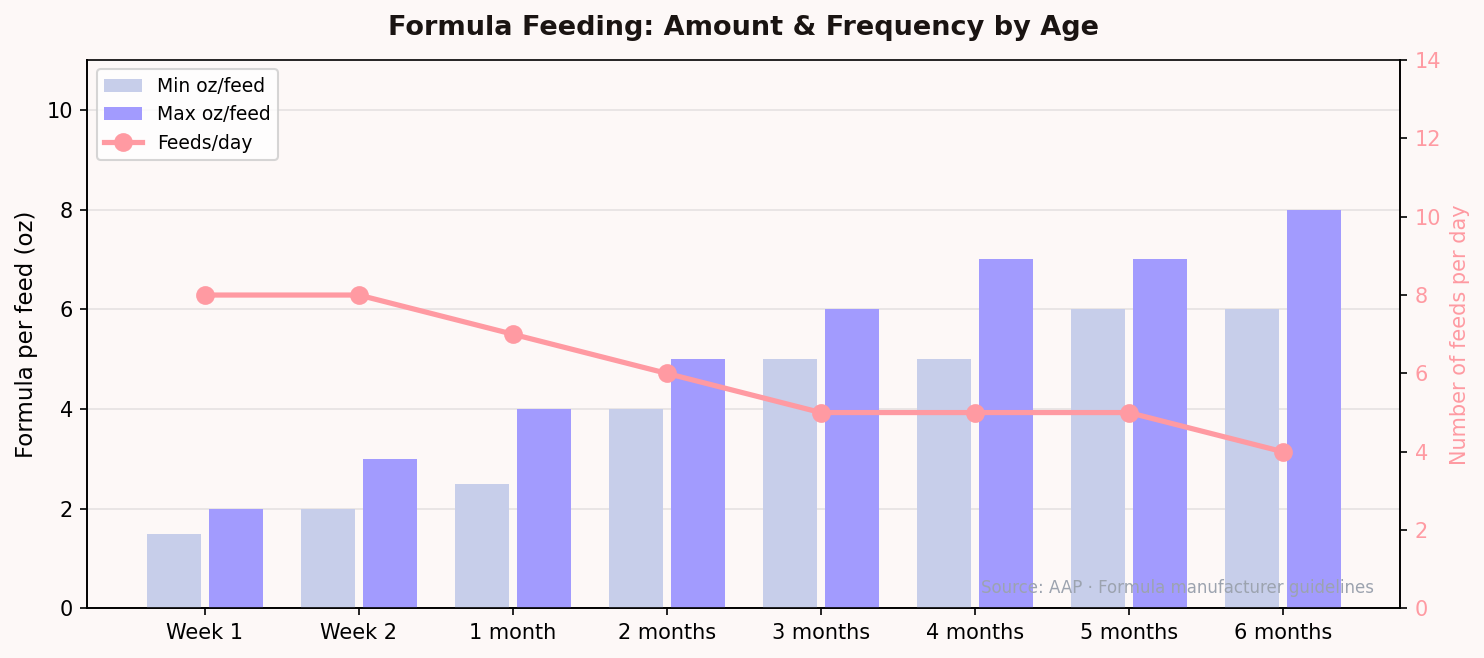
Formula feeding amounts and frequency guidelines by age. Always consult your pediatrician for individual guidance.
Types of Infant Formula
Standard Cow's Milk-Based Formula
The most widely used type, recommended for healthy term infants unless there's a specific medical reason to use something else. Cow's milk-based formula undergoes extensive processing to make it suitable for infants — the protein is modified to be more digestible, and the fat composition is adjusted to better resemble breast milk. Most standard formulas are fortified with iron (essential for brain development), DHA and ARA (fatty acids important for brain and eye development), and a range of vitamins and minerals.
Partially Hydrolysed Formula (HA or "Comfort" Formula)
The proteins in these formulas have been partially broken down ("hydrolysed"), making them easier to digest. They are marketed for colicky or fussy babies, but the evidence for their superiority over standard formula for typical colic is mixed. They may be appropriate for babies with mild lactose sensitivity or a family history of allergy. They are NOT suitable for babies with confirmed cow's milk protein allergy.
Extensively Hydrolysed Formula (eHF)
The protein is broken down much more completely — to short peptide chains. These are used for infants with confirmed cow's milk protein allergy (CMPA) or severe lactose intolerance. They require a prescription or recommendation from a healthcare provider. Most babies with CMPA tolerate eHF well.
Amino Acid Formula (AAF / Elemental Formula)
Protein is provided in its most basic form (individual amino acids). Used for severe CMPA when eHF is not tolerated, or for other severe gastrointestinal conditions. Requires medical supervision.
Soy Formula
Soy-based formula is suitable for infants whose parents prefer a plant-based option, or for infants with galactosemia (inability to metabolize galactose). It is not recommended as a first-line treatment for cow's milk protein allergy because up to 50% of infants with CMPA also react to soy. The AAP notes soy formula is nutritionally adequate but does not recommend it preferentially over cow's milk formula.
Organic Formula
Organic formula meets the same nutritional requirements as conventional formula but uses organic ingredients. There is no evidence that organic formula has health benefits over conventional formula. The choice is personal. In several countries, organic formulas are not required to be fortified with certain nutrients at the same level — check labels carefully.
Specialty Formulas
These include: anti-reflux formulas (thickened with rice starch or carob bean gum), pre-term formulas (higher calories and protein), and metabolic formulas for specific inborn errors of metabolism (e.g., PKU). These should only be used under medical guidance.
How to Choose a Formula
For most healthy term babies, a standard iron-fortified cow's milk-based formula is appropriate. When comparing brands, know that within the same category, all formulas sold in the US and UK must meet strict regulatory standards (FDA in the US, EU regulations in the UK/Europe) — so the nutritional difference between regulated brands is small. "Premium" marketing does not necessarily indicate nutritional superiority. If in doubt, ask your pediatrician.
Formula Preparation: Safety Essentials
Incorrect formula preparation is a genuine safety issue. Follow these steps every time:
- Wash hands thoroughly with soap and water before preparing formula.
- Sterilize bottles and equipment — especially in the first 3 months and for premature babies. Use a steam sterilizer, dishwasher (60°C+ cycle), or boiling method.
- Boil fresh water and allow it to cool to no lower than 70°C (158°F). Water at this temperature kills Cronobacter sakazakii, a bacterium that can contaminate powdered formula during manufacturing. Do not use bottled water — it is not sterile.
- Measure water first, then add the correct number of level scoops of powder. Never heap scoops or pack the powder. One scoop per the formula's instructions only.
- Close the bottle and shake. Cool under cold running water until the formula is body temperature (~37°C / 98.6°F). Test on your wrist.
- Use immediately, or store in the back of the refrigerator and use within 24 hours. Never reheat formula that has been offered to the baby (saliva backwash begins bacterial growth).
- Never microwave formula — it creates uneven hot spots that can burn your baby's mouth.
Water Temperature Is Critical Premature babies born at 26 weeks require specialist preterm formula with different caloric density than standard newborn formula — regular formula is not appropriate until corrected term.
Water must be at least 70°C (158°F) to safely reconstitute powdered formula. Water that has been boiled and cooled for more than 30 minutes may fall below this threshold. Pre-made liquid formula is a sterile alternative that avoids this risk entirely.
How Much Formula Does My Baby Need?
| Age | Amount per Feed | Feeds per Day | Total per Day |
|---|---|---|---|
| Week 1 | 30–60 ml (1–2 oz) | 8–12 | ~300–600 ml |
| Week 2–4 | 60–90 ml (2–3 oz) | 7–9 | ~500–700 ml |
| Month 1–2 | 90–120 ml (3–4 oz) | 6–8 | ~600–800 ml |
| Month 2–3 | 120–150 ml (4–5 oz) | 5–7 | ~700–900 ml |
| Month 4–6 | 150–180 ml (5–6 oz) | 4–6 | ~800–1000 ml |
| Month 6–9 | 180–210 ml (6–7 oz) | 3–5 | ~700–900 ml (reducing as solids increase) |
| Month 9–12 | 180–210 ml (6–7 oz) | 3–4 | ~600–700 ml |
Note: These are averages. Your baby's hunger cues are the best guide. Never force a baby to finish a bottle. A general rule of thumb is approximately 150 ml per kg of body weight per day (up to around 5 kg), but follow your pediatrician's guidance.
Responsive Bottle Feeding
Responsive (or paced) bottle feeding is the formula feeding equivalent of responsive breastfeeding. It prevents overfeeding and helps babies learn to self-regulate hunger and fullness. Key techniques:
- Hold baby in a semi-upright position (not lying flat)
- Hold the bottle horizontally, just tilted enough for milk to reach the teat tip — no rushing
- Pause every few minutes to burp and check for hunger/fullness cues
- Stop when baby shows "done" cues: turning head away, closing mouth, losing interest, becoming distracted
- Never prop the bottle or leave baby alone to feed
Signs of Formula Intolerance
Some babies don't tolerate a particular formula well. Signs that may indicate intolerance include:
- Cow's milk protein allergy (CMPA): Blood in stool (streaks or bright red), persistent eczema, vomiting after every feed, severe/persistent colic, failure to thrive. CMPA affects ~2% of formula-fed infants. Requires an extensively hydrolysed or amino acid formula under medical supervision.
- Lactose intolerance: Watery, frothy, explosive stools, excessive wind, bloating. True primary lactose intolerance is rare in infants — secondary lactose intolerance can occur after a gastroenteritis episode.
- Reflux: Frequent vomiting, crying during feeds, arching back. Many babies have some reflux; significant reflux may respond to anti-reflux formula (always discuss with pediatrician first).
If you suspect formula intolerance, contact your pediatrician before switching formulas. Switching unnecessarily can cause its own problems.
Combination Feeding (Breastfeeding + Formula)
Combination feeding — both breastfeeding and formula feeding — is a completely valid approach. It can allow partners to share night feeds, support a low milk supply, or ease the transition back to work. Key considerations:
- Try to establish breastfeeding first (usually by 4–6 weeks) before introducing bottles, to protect supply
- Use responsive bottle feeding techniques to minimize "bottle preference"
- Be aware that formula supplementation reduces breast stimulation and may gradually reduce milk supply over time
- A lactation consultant can help design a combination feeding plan that meets your goals
Formula Safety: The 2022 Shortage and Preparedness
The 2022 US infant formula shortage highlighted the vulnerability of formula-dependent families. To build resilience:
- Keep a 2-week supply on hand when possible
- Know equivalent substitute formulas in your brand's category (ask your pediatrician)
- Never dilute formula to stretch supply — this is dangerous and can cause hyponatremia (dangerous drop in blood sodium)
- Never make homemade formula — it cannot meet an infant's complete nutritional needs and poses serious safety risks
- Never give cow's milk as a primary drink before 12 months — it is not nutritionally appropriate for infants under 1 year
Frequently Asked Questions
Which formula is closest to breast milk?
No formula fully replicates the complexity of breast milk, which contains living cells, antibodies, and hundreds of bioactive compounds. However, modern cow's milk-based infant formulas are designed to approximate the macronutrient and micronutrient profile of breast milk as closely as current technology allows. Formulas with added DHA/ARA, HMO (human milk oligosaccharides), and probiotic strains aim to narrow the gap further. Within the standard category, differences between brands are small. Ask your pediatrician if you have specific concerns.
Can I switch formula brands?
Yes, within the same category (e.g., standard cow's milk to standard cow's milk). Formulas of the same type are nutritionally equivalent regardless of brand. Some babies show temporary digestive adjustment (fussiness, gas, stool changes) when switching formulas, but this usually resolves within a week. Switching between categories (e.g., standard to extensively hydrolysed) should be done with medical guidance.
How do I know if my baby is still hungry after a bottle?
Hunger cues include: rooting, sucking on hands, fussiness, and mouthing. After a feed, a satisfied baby will seem relaxed, stop sucking, and may fall asleep or be contentedly alert. If your baby consistently seems hungry within an hour of a full feed, discuss with your pediatrician — they may recommend increasing the amount per feed.
Is it safe to use formula after the expiry date?
No. Do not use formula past the printed use-by date. After this date, the nutritional content may be degraded and the safety cannot be guaranteed. Also do not use formula from dented, rusted, bulging, or otherwise damaged cans.
Can I use tap water to make formula?
In countries with good municipal water quality (such as the US, UK, Australia, Canada), tap water is generally safe to use after boiling. However, if your home has lead pipes, a private well, or if you live in an area with water quality concerns, use bottled water (single-use) or a certified water filter. Note: boiled and cooled tap water, not bottled water, is recommended by WHO for formula preparation as bottled water is not sterile.
References
- American Academy of Pediatrics. (2022). Infant Formula. https://www.healthychildren.org/English/ages-stages/baby/formula-feeding/
- U.S. Food & Drug Administration. (2023). Infant Formula. https://www.fda.gov/food/nutrition-food-labeling-and-critical-foods/infant-formula
- World Health Organization. (2022). How to prepare formula for bottle-feeding at home. https://www.who.int/publications/i/item/9789241598490
- ESPGHAN Committee on Nutrition. (2022). Appropriate use of infant formula. Journal of Pediatric Gastroenterology and Nutrition, 74(4), 590–600. https://doi.org/10.1097/MPG.0000000000003459
Your complete baby guide — free
Month-by-month milestones, sleep science, feeding roadmap, and 100+ expert tips. Science-backed, always free.
Open BabyBloom free →No account needed · No credit card